Feasibility Screening
Early review of part geometry, material behavior, and annual demand against forming logic.

WHATSAPP: +86 13544137314
Cold Heading
A strong route for the right geometry when production throughput, material efficiency, and repeat economics matter more than pure process flexibility.
Workflow
Near-net-shape forming route
Program fit
Recurring and stable annual demand
Review focus
Geometry suitability and secondary ops
Cold Heading
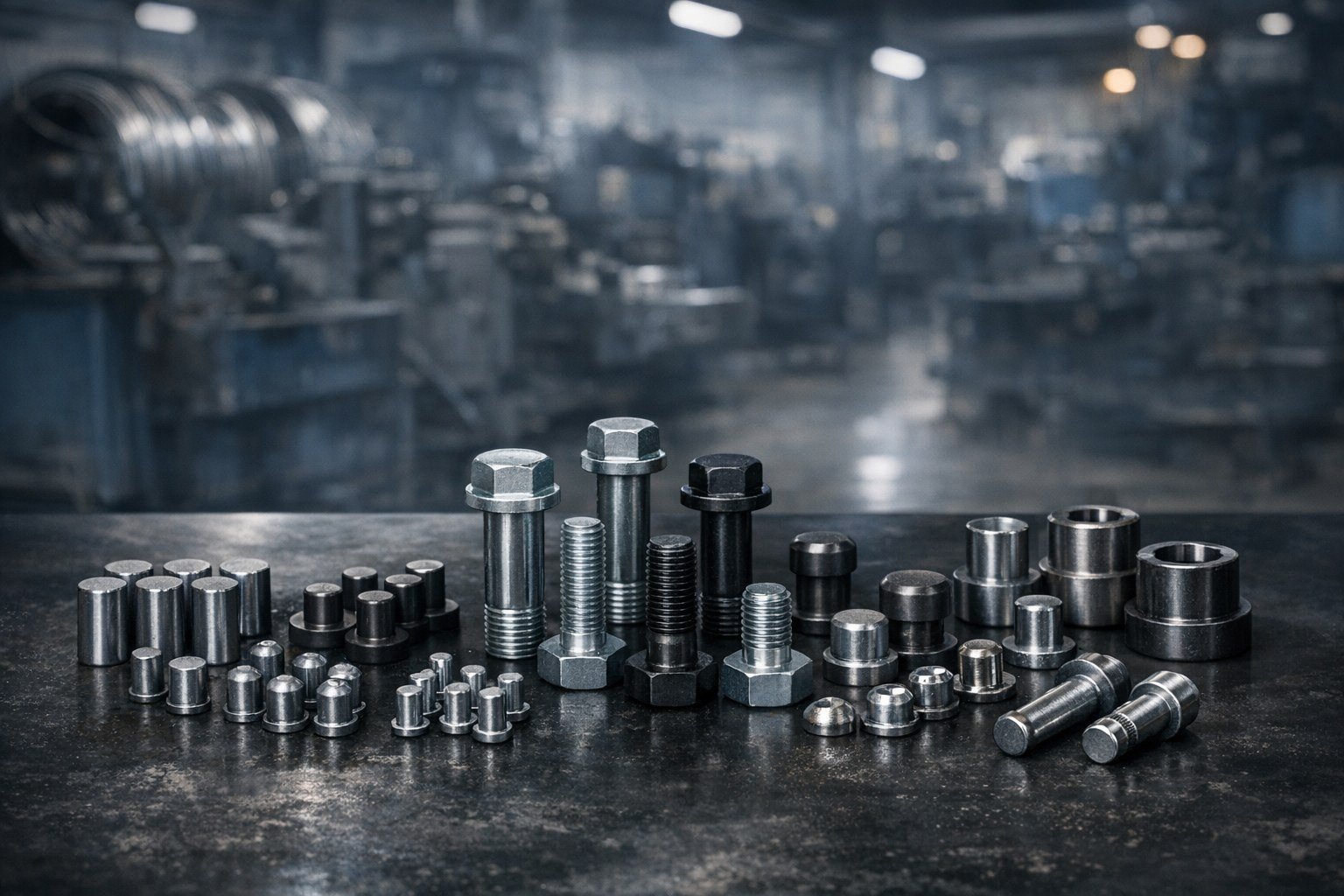
Cold heading is best for parts that naturally fit a forming route and have the volume profile to justify tooling efficiency. It is commonly used for hardware blanks, pins, studs, headed components, and similar parts where repeat output and material usage drive long-term cost performance.
Program fit
This page is built to explain where the process belongs, what risks should be screened early, and how ELUFA approaches technical review before release.
Cold Heading
Early review of part geometry, material behavior, and annual demand against forming logic.
Process sequence and tooling concept aligned to risk points before release.
Targeted thread, trim, or precision finishing only where function requires it.
Repeat-lot control built around the agreed process window and checkpoints.
Process review
The mistake with cold heading is pushing parts into the process because the unit cost looks attractive on paper. The real question is whether the geometry, tolerances, and expected volume make the tooling investment practical.
Review goal
The objective is not to make the page sound technical. The objective is to make the RFQ and sample path more predictable.
Cold Heading
Step 01
Assess geometry, material, tolerance load, and production demand.
Step 02
Define the forming sequence and expected process checkpoints.
Step 03
Approve headed samples and any secondary-operation output.
Step 04
Run recurring lots with monitoring on critical dimensions and traceability.
FAQ
No. It is efficient for the right geometry and volume profile, but not a universal replacement.
A hybrid route is common: heading for the base form plus limited secondary machining where it truly matters.
Usually when demand is stable enough that throughput and material-efficiency gains can be realized over time.
Send the drawing and annual demand estimate. We will tell you if cold heading, machining, or a hybrid route is more practical.
Discuss Cold Heading